

Motorized Patio Screens: A More Flexible Way to Enjoy Your Patio
You chose the furniture. You planned the landscaping. You finally have a patio that looks the way you imagined.
But do you use it the way you imagined?
Perhaps the afternoon sun reaches the same chair every day. Maybe insects interrupt dinner. Or the seating area feels more exposed to neighboring properties than you expected.
Before reconsidering the entire space, look at its open sides.
Motorized patio screens add an adjustable screening layer to suitable outdoor openings. Depending on the selected material and installation, they can help address sun exposure, insects, or privacy concerns while giving you the option to raise the screens when you prefer a more open setting.
Start with what sends you indoors
The most useful starting question is not, “Which screen looks best?”
It is, “What keeps us from enjoying this space?”
For one household, the answer might be sunlight across an outdoor television. For another, it might be wanting a more comfortable place to eat without constantly moving chairs.
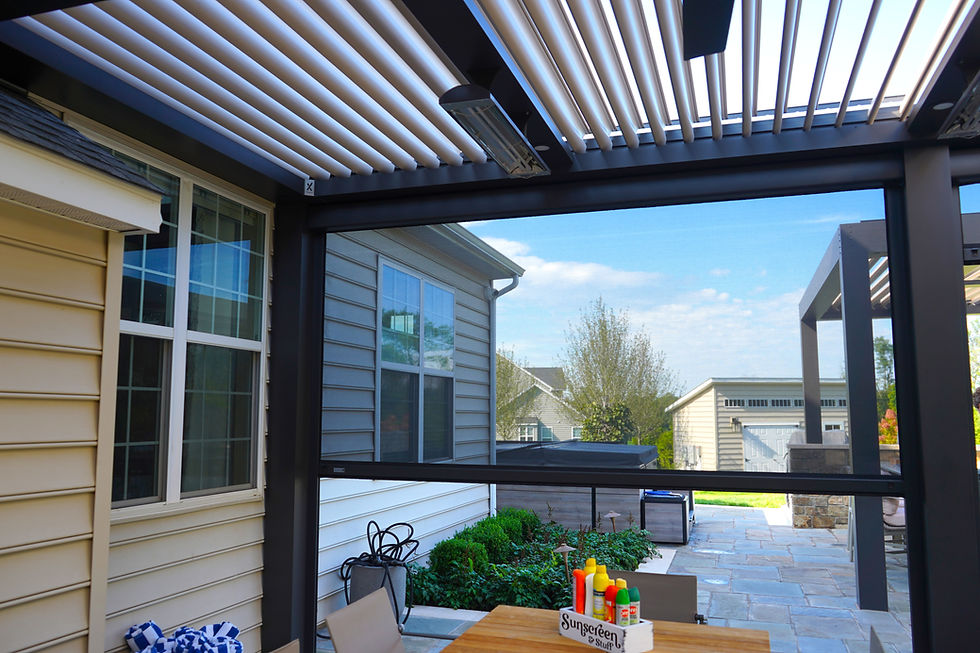
Identify the problem and the time it happens. A photograph taken from your seat can tell a designer more than a general description of a patio that feels “too sunny.”
That information helps guide which openings deserve attention and what screening characteristics should be considered.
Think beyond simply adding shade
An overhead roof and a side screen address different parts of an outdoor space. A covered patio can still receive sunlight through an open side. Adding more overhead coverage may not address the direction that light is coming from.
Motorized screens introduce another way to adjust the space without committing to a permanently lowered screen across every opening.
The goal is not to close off the backyard. It is to give you more control over the part of it where you spend time.
Set realistic expectations for privacy
Privacy deserves a specific conversation.
Solar screen fabrics can provide daytime privacy, but visibility changes with lighting conditions. When a patio is brightly lit after dark, people outside may be able to see inward. A fabric that feels private during an afternoon visit may perform differently during an evening gathering.
Explain when privacy matters most, then review appropriate material options rather than assuming every screen provides the same result.
You may not need to screen every side
Picture a patio with one side facing a neighboring property and another overlooking a garden.
Those openings serve different purposes. One may benefit from added screening, while preserving openness on the other may be a priority.
For insect-management goals, however, the complete layout matters. Open sides and other gaps remain possible entry points. Selective screening should match the problem you are trying to address.
Use your next afternoon outside as a planning session
Sit where you normally sit. Notice which chair gets moved, where people gather, and when someone suggests going inside.
Those small observations are valuable design information.
A better outdoor space does not always begin with a bigger footprint.
Sometimes, it begins with making the space you already have more adaptable.
Ready to explore motorized screens for your patio? Schedule a design appointment with Distinctive Outdoor Structures.


Comments